

HSE University Holds 10th Summer School ‘Eye-tracking in the Lab and Beyond’
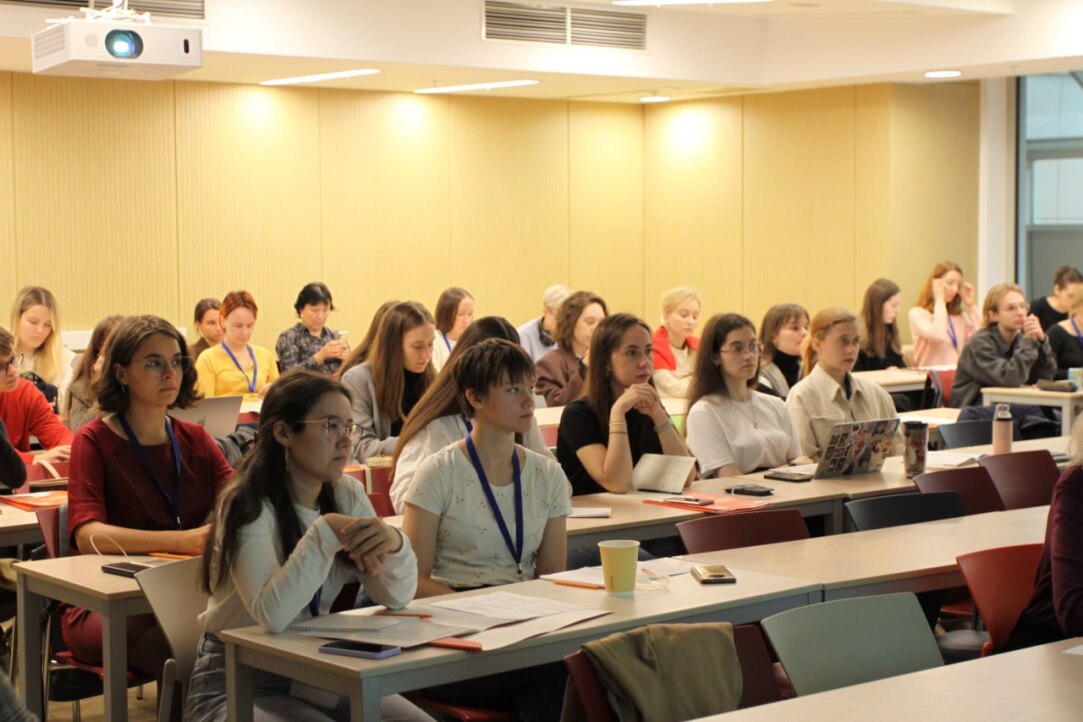
This year, more than 100 students from Russia and abroad took part in the 10th summer neurolinguistic school, ‘Eye-tracking in the Lab and Beyond’. The school is held annually by the HSE Center for Language and Brain. Leading experts spoke about advanced developments and research in the field of video-oculography.
Video-oculography, or eye-tracking, is a modern research method that allows scientists to record eye movements using powerful equipment including special portable glasses equipped with video cameras.
HSE Center for Language and Brain is one of the leading Russian scientific organisations engaged in research within the field of video-oculography. Since opening in 2018, the centre has conducted multiple studies with the participation of children and adults, as well as speakers of rare languages, such as Adyghe and Tuyuk. In addition, the centre’s video-oculographic studies have made a great contribution to the study and development of methods for correcting reading problems in children.

Anastasia Lopukhina, researcher at the University of London, presented an overview of recent studies on eye movement during reading in children. Studies have shown that the transparency of spelling affects the speed at which children learn to read. In addition, Anastasia talked about whether TV subtitles in their native language can help children develop their reading skills faster.
Irina Sekerina, a researcher from New York University, spoke about experiments which register eye movements using a webcam. This new methodology gained particular popularity during the COVID-19 pandemic, because it allows scientists to conduct research and collect data online without using expensive equipment. Despite the fact that the methodology has a number of limitations, its accessibility has great potential for conducting psycholinguistic research.
The report of Svetlana Alekseeva, senior researcher at the Institute for Cognitive Studies of St. Petersburg State University, was devoted to the study of eye movements for testing Cyrillic fonts, including the recently developed Cyrillic LexiaD font adapted for people with dyslexia.
On the second day of the school, Anna Izmalkova, research fellow at HSE Centre for Cognition & Decision Making, spoke about eye movement research in the field of visual searches and problem solving strategies. Based on the analysis of eye movement patterns and mistakes made, researchers can conclude what strategy a person uses when learning new words.
Anna Laurinavichyute, a postdoctoral researcher at the University of Potsdam, presented a report on traditional methods of analysing and processing video-oculographic data, as well as on new, more accurate and complex approaches that will improve the quality of video-oculographic research.
The report of Soroosh Shalileh, research fellow at the Center for Language and Brain, head of the Vision Modelling Laboratory, was devoted to the diagnosis of dyslexia based on machine learning and eye movement analysis. This diagnostic method has an advantage over traditional screening, which may require a lot of time and the involvement of highly qualified specialists, so its use should lower the age at which dyslexia is detected.
Representatives of ‘Neuroiconics’ made a presentation ‘From simple to complex. Modern solutions in the field of video-oculography in science, education, medicine and neuromarketing’ and demonstrated modern video oculographs.

During the school, Anna Izmalkova and Tatiana Ledneva, research assistant at HSE Centre for Cognition & Decision Making, held a workshop on working within the ‘Eye Movement Modeling Example’ paradigm. This approach is widely used to improve the efficiency of knowledge transfer during interaction between an expert and a novice in an educational context.
Elena Gorbunova, Head of HSE Laboratory for Cognitive Psychology of Digital Interface Users, spoke about the use of video-oculography in UX research. This method can be used to determine patterns of user behavior — for example, to determine a strategy for finding information or to identify what exactly the user focuses on while working with a particular interface.

‘It is important for us that the participants of the school were able to learn more about the areas of work of the Center for Language and Brain and talk about their research in the field of video-oculography. The great interest in this area confirms its relevance, and together we will make many more important discoveries,’ said Olga Dragoy, director of the Center for Language and Brain.
The school was held with the support of the HSE Human Capital Multidisciplinary Research Centre.
See also:

Researchers Identify Link between Bilingualism and Cognitive Efficiency
An international team of researchers, including scholars from HSE University, has discovered that knowledge of a foreign language can improve memory performance and increase automaticity when solving complex tasks. The higher a person’s language proficiency, the stronger the effect. The results have been published in the journal Brain and Cognition.
‘Engagement in the Scientific Process’: HSE Launches Master’s Programme in Neurobiology
The HSE University Academic Council has elected to launch a new Master's programme in Neurobiology for students majoring in Biology. Students of the programme will have access to unique equipment and research groups, providing them with the knowledge and experience to pursue careers in science, medicine and pharmacy, IT and neurotechnology, and education and HR services.
Scientists Discover That the Brain Responds to Others’ Actions as if They Were Its Own
When we watch someone move their finger, our brain doesn’t remain passive. Research conducted by scientists from HSE University and Lausanne University Hospital shows that observing movement activates the motor cortex as if we were performing the action ourselves—while simultaneously ‘silencing’ unnecessary muscles. The findings were published in Scientific Reports.
Russian Scientists Investigate Age-Related Differences in Brain Damage Volume Following Childhood Stroke
A team of Russian scientists and clinicians, including Sofya Kulikova from HSE University in Perm, compared the extent and characteristics of brain damage in children who experienced a stroke either within the first four weeks of life or before the age of two. The researchers found that the younger the child, the more extensive the brain damage—particularly in the frontal and parietal lobes, which are responsible for movement, language, and thinking. The study, published in Neuroscience and Behavioral Physiology, provides insights into how age can influence the nature and extent of brain lesions and lays the groundwork for developing personalised rehabilitation programmes for children who experience a stroke early in life.
Scientists Uncover Why Consumers Are Reluctant to Pay for Sugar-Free Products
Researchers at the HSE Institute for Cognitive Neuroscience have investigated how 'sugar-free' labelling affects consumers’ willingness to pay for such products. It was found that the label has little impact on the products’ appeal due to a trade-off between sweetness and healthiness: on the one hand, the label can deter consumers by implying an inferior taste, while on the other, it signals potential health benefits. The study findings have been published in Frontiers in Nutrition.
Cardiogenetics of the Future: Sequencing Helps Treat Heart Disease
Future cardiologists, geneticists, and IT specialists gathered at HSE University to learn how to 'read' DNA for diagnosing cardiovascular diseases. They explored modern sequencing methods and the complexities of working with digital twins of cardiac patients.
Internal Clock: How Heart Rate and Emotions Shape Our Perception of Time
Our perception of time depends on heart rate—this is the conclusion reached by neuroscientists at HSE University. In their experiment, volunteers watched short videos designed to evoke specific emotions and estimated each video's duration, while researchers recorded their heart activity using ECG. The study found that the slower a participant's heart rate, the shorter they perceived the video to be—especially when watching unpleasant content. The study has been published in Frontiers in Psychology.
Archival Impulse: Dubna Hosts Summer School Organised by HSE University and JINR
The Joint Institute for Nuclear Research (JINR) in Dubna hosted the Archival Impulse Summer School, co-organised by JINR physicists, historians from the HSE Faculty of Humanities, and staff from the Archives of the Russian Academy of Sciences (ARAS). This first archival summer school continued the joint initiative of HSE University and JINR to examine and preserve the unique historical legacy of physicists.
Scientists Develop New Method to Detect Motor Disorders Using 3D Objects
Researchers at HSE University have developed a new methodological approach to studying motor planning and execution. By using 3D-printed objects and an infrared tracking system, they demonstrated that the brain initiates the planning process even before movement begins. This approach may eventually aid in the assessment and treatment of patients with neurodegenerative diseases such as Parkinson’s. The paper has been published in Frontiers in Human Neuroscience.
HSE Shares Its Experience of Urban Strategies at International Summer School in China
In the context of intensifying global geopolitical and technological competition, leading Chinese educational institutions—Zhejiang International Studies University and Peking University—organised an International Summer School. Their joint programme focused on studying global, regional, and urban development strategies. The HSE Faculty of Urban and Regional Development took part in this event.