

Students of Engineering and Mathematics School Present First Project Results
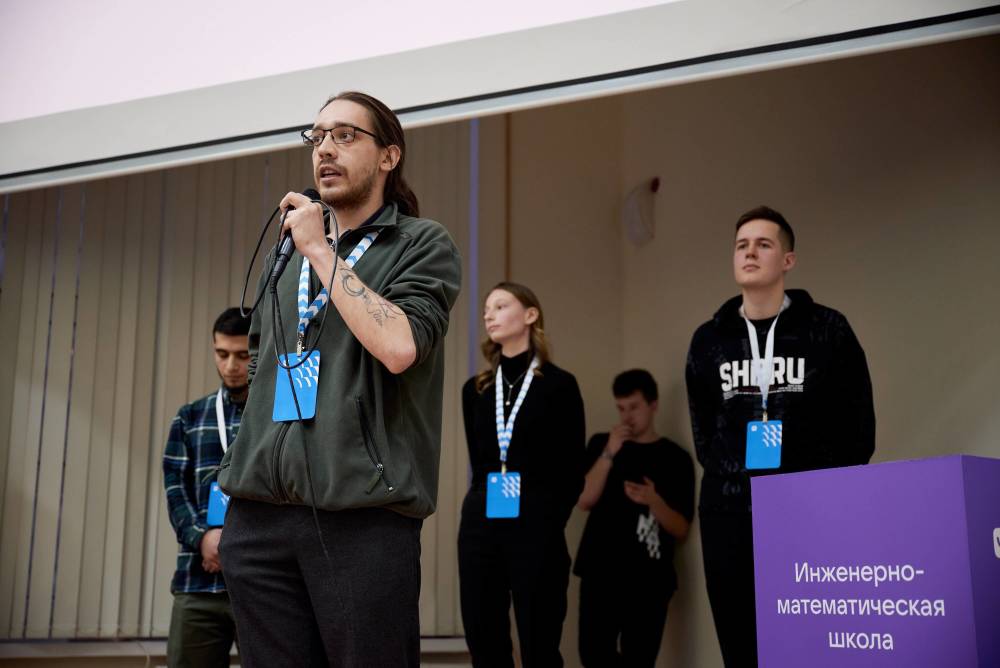
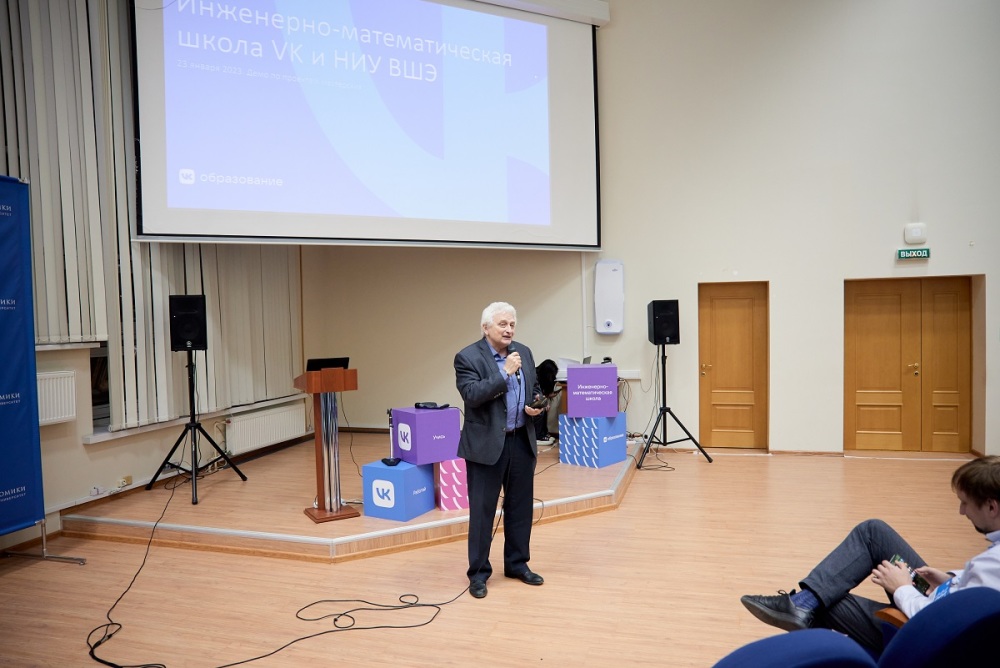

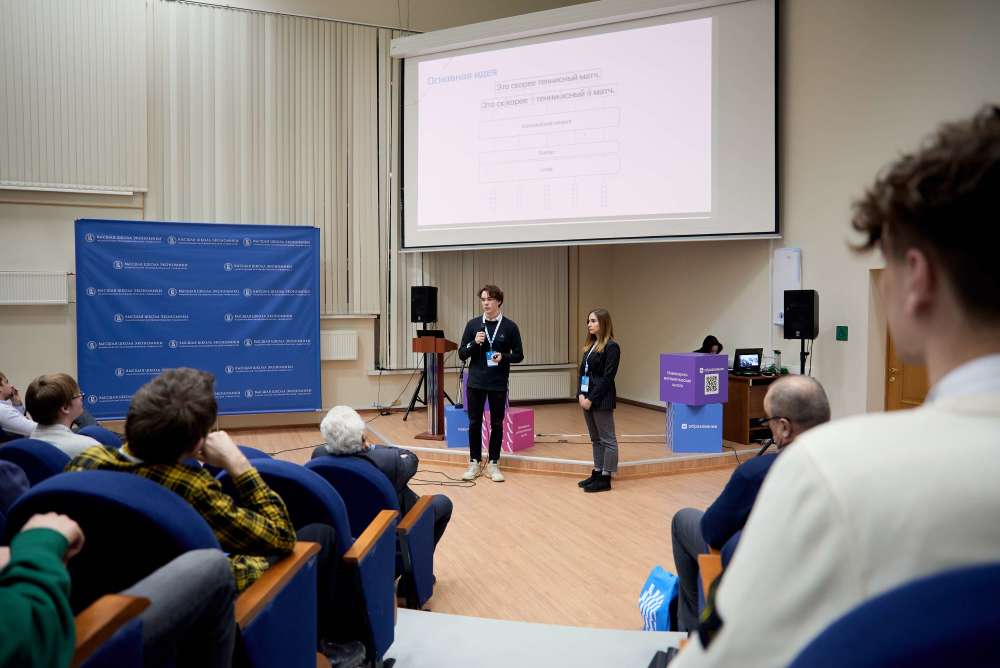
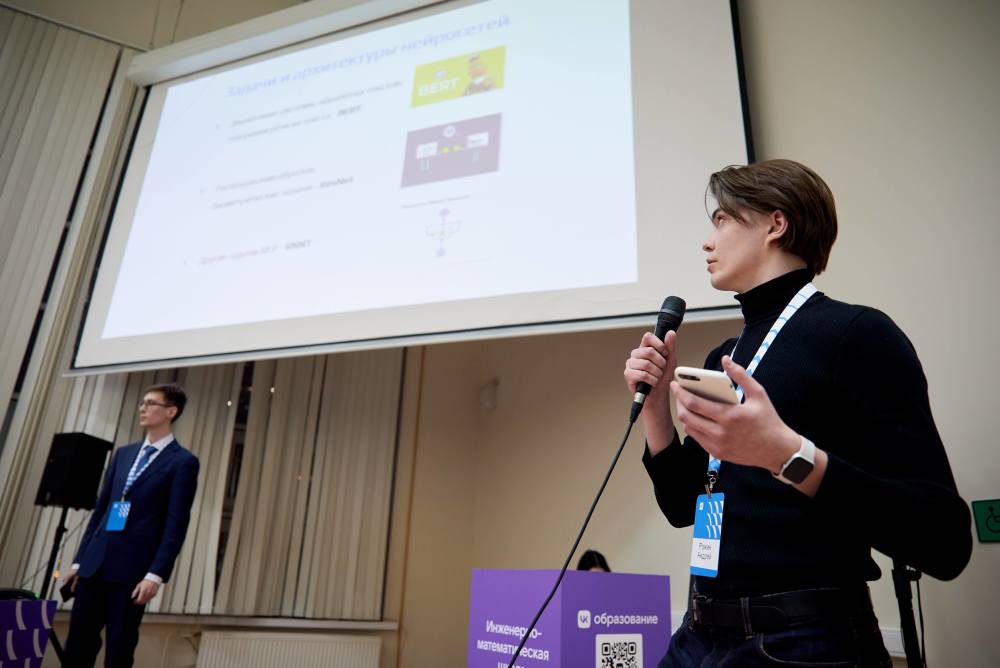


Students of the Engineering and Mathematics School (EMS) launched by HSE University and VK in October 2022 held a Demo Day to showcase the first results of their product- and research-based IT projects. Work on the projects has been conducted under the supervision of experts from the university and mentors from VK.
As part of the EMS, HSE University students work on real business tasks from VK in workshops (laboratories) in relevant and in-demand IT fields. They also take tailored training courses led by HSE lecturers and VK experts.
The main project areas are compilers, high-load systems, and AI technologies. Project work has been divided into four corresponding workshops in:
compilers and high-load systems
virtual platform solutions
AI hardware
applied AI
The team of the Compilers and High-Load Systems workshop (at HSE MIEM) has several key tasks. These include adapting libraries written in PHP for compiling in KPHP, developing new uncompilable libraries, and generating code for conversion into C++.
Dmitry Abramov, Compilers and High-Load Applications workshop (HSE MIEM)
‘With seven people, ours is the biggest workshop. We started out with eight, but one of our colleagues left for personal reasons after implementing a major task and publishing an article on KPHP on HABR. The size of the team is down to the fact that we are developing the KPHP ecosystem in every field and writing libraries for all situations.
By the end of the academic year, we plan to present a finished framework for use on VK, as well as publish several practical articles on the course of the work.’
The developments made by the workshop will allow third-party developers to adapt their PHP code more easily in order to achieve the productivity offered by KPHP through conversion into C++.
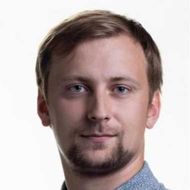
Fedor Ivanov, Head of the Engineering and Mathematics School
‘Demo Day is a platform where participants of all EMS workshops can meet to discuss the results of their projects and their plans for the future in an informal setting. This format of communication facilitates the emergence of new and interesting ideas and unexpected collaborations. I believe that the event was a success—instead of a formal presentation of results, there was lively discussion and the exchange of opinions and ideas. I am confident that this format—which we plan to continue using in the future—will facilitate the continued development of the EMS overall and each of its participants individually.’
The Robbi workshop (at HSE University-St Petersburg) presented a minimum viable prototype of the Robbi web platform in the dev cloud. The team’s work helps to solve machine learning tasks so that businesses do not have to hire developers or preserve their own infrastructure.
The team of the AI Hardware workshop (HSE MIEM) conducted an analysis of domestic AI platforms and software in light of the mass departure of international manufacturers from the Russian market. The workshop’s plans include the development of a platform for working with AI based on Russian hardware.
The Applied AI workshop (HSE MIEM) presented the results of the use of visual text representation in NLP tasks. This makes it possible to work with texts where the user tries to fool existing solutions by substituting characters with similar-looking ones. Under the guidance of a mentor from VK, the project is working to improve the quality of solutions for finding toxic comments by adding optical character recognition (OCR) technologies.
Nikita Shevtsov, Applied AI workshop (MIEM HSE)
‘A 3D model of a human consists of many components: a polygon mesh, a texture, a skeleton. Today, we can use photos to construct a 3D model and obtain a skeleton for animation. The next step is to learn to add textures to an avatar, then further develop all aspects of the system in order to assemble a full-fledged end-to-end solution.’
As part of the computer vision field, the team of the AI workshop presented the results of its research into the 3D reconstruction of the human body and the construction of a universal model for identifying key points of human and animal faces. This research is necessary for the development of the AR effects industry.
The teams of the EMS workshops continue to work on tasks from VK and attend training courses from the company’s experts in machine learning, data analysis, web technologies and other relevant fields.
Students are motivated to stay focused on their projects not only because of interesting tasks and the opportunity to communicate with top IT experts, but also thanks to a monthly bursary of 40,000 roubles from VK. The knowledge and experience gained as part of the EMS will be advantageous to candidates applying for internships and employment at VK.
In the near future, the EMS will announce an additional intake of participants for the workshop teams. You can follow the latest news about the project in the VK groups for HSE MIEM, the St Petersburg School of Physics, Mathematics, and Computer Science and on the website and VK community of VK Education.
See also:

HSE University Wins Seven Medals at International Mathematics Competition for University Students
HSE students were among the winners of the International Mathematics Competition for University Students (IMC), which was held in August in Bulgaria. The medallists are students of the HSE Faculty of Computer Science (FCS) programme in Applied Mathematics and Information Science and the Faculty of Mathematics programme in Mathematics.
‘Our Result Was Recognised Not Only Within the Project Defence but Also on International Scale’
This year, the European AI Conference (ECAI 2025) accepted an article titled ‘Multi-Agent Path Finding for Large Agents is Intractable’ by Artem Agafonov, a second-year student of the Applied Mathematics and Information Science Bachelor’s programme at HSE University’s Faculty of Computer Science. The work was co-authored by Konstantin Yakovlev, Head of the Joint Department with Intelligent Technologies of System Analysis and Management at the Federal Research Centre ‘Informatics and Management’ of the RAS and Associate Professor at the Faculty of Applied Sciences. In the interview, Artem Agafonov explained how he came up with the idea for the article and how he was able to present it at an A-level conference.
'Today, Human Existence Without Mathematics Is Difficult; Tomorrow, It Will Be Simply Impossible'
Mathematicians around the world share a common language and continue to collaborate despite the challenges of recent years. The hub of mathematical networking has been shifting to China, where scientists from various countries meet at conferences and other academic events. Partnerships with leading Chinese universities offer promising opportunities to strengthen existing ties and forge new ones. In this interview with the HSE News Service, Valery Gritsenko, Head of the HSE International Laboratory for Mirror Symmetry and Automorphic Forms, discusses this and other topics, including what AI is and why the state should engage with mathematicians.
HSE Scores Best Results among Russian Universities at International Olympiad in Uzbekistan
At the Third Al-Khorezmi International Mathematical Olympiad (AKHIMO), held at Urgench State University in Uzbekistan, students from HSE University's Faculty of Computer Science scored best results among participants from Russian universities. The olympiad also featured contestants from Brazil, the USA, China, India, South Korea, Malaysia, Japan, Vietnam, Serbia, Kyrgyzstan, Kazakhstan, Tajikistan, Turkey, Turkmenistan, and Uzbekistan.
Russian Scientists Assess Dangers of Internal Waves During Underwater Volcanic Eruptions
Mathematicians at HSE University in Nizhny Novgorod and the A.V. Gaponov-Grekhov Institute of Applied Physics of the Russian Academy of Sciences studied internal waves generated in the ocean after the explosive eruption of an underwater volcano. The researchers calculated how the waves vary depending on ocean depth and the radius of the explosion source. It turns out that the strongest wave in the first group does not arrive immediately, but after a significant delay. This data can help predict the consequences of eruptions and enable advance preparation for potential threats. The article has been published in Natural Hazards. The research was carried out with support from the Russian Science Foundation (link in Russian).
'The Six Handshakes Rule Applies to Social Media'
Ivan Samoylenko specialises in graph theory; in his third year of university, he developed an idea that later became the foundation of a highly cited academic article. In this interview with the HSE Young Scientists project, he speaks about the Watts-Strogatz small-world model, being a performer in the Bolshoi Children's Choir, and making the choice between science and industry.
‘HSE Is a Very Good Place: Intelligent Students, a Strong Teaching Staff’
Since March 2025, the HSE Faculty of Mathematics has welcomed a leading Russian mathematician, Doctor of Physical and Mathematical Sciences, Honorary Professor at the University of Edinburgh, National Professor of China, and recipient of the Lyapunov Prize—Sergey Kuksin. In an interview with the HSE News Service, he spoke about the role of the individual in mathematics, KAM theory, and why analysis is so relevant today.
Scientists Disprove Bunkbed Conjecture
Mathematicians from Russia, including two HSE graduates, have disproven a well-known mathematical conjecture that, despite lacking solid proof, had been considered valid for 40 years. The ‘Bunkbed Conjecture’ belongs to percolation theory—a branch of mathematics that studies the formation of connected structures in independent environments.
'Our Mathematics Is for Far-Reaching Minds'
Anna Presnova focuses on automatic control theory, a branch of science that addresses global problems. In this interview with the HSE Young Scientists project, she talks about her aspiration to achieve practical results, the energy she gains from teaching, and why she would be interested to meet with Alexandr Lyapunov, founder of stability theory.
'It Was a Great Learning Experience for the New Generation of Mathematicians'
From November 5 to 9, 2024, HSE University hosted a five-day conference on algebraic geometry and mathematical physics, organised jointly with the Beijing Institute of Mathematical Sciences and Applications. Over 30 mathematicians from the world's leading universities, including early-career scientists, participated in the event.