

New Method for Describing Graphene Simplifies Analysis of Nanomaterials

An international team, including scientists from HSE University, has proposed a new mathematical method to analyse the structure of graphene. The scientists demonstrated that the characteristics of a graphene lattice can be represented using a three-step random walk model of a particle. This approach allows the lattice to be described more quickly and without cumbersome calculations. The study has been published in Journal of Physics A: Mathematical and Theoretical.
Graphene is one of the most recent and widely discussed materials of the 21st century. It consists of a single layer of carbon atoms arranged in a honeycomb, hexagonal lattice structure. Graphene is exceptionally strong, an excellent conductor of electricity, nearly transparent, and highly flexible. It has already been used in the production of conductive films, sensors, and miniature transistors. Similar structures occur in other carbon forms, such as fullerenes—closed spherical molecules composed of pentagons and hexagons—used in drug delivery and solar cell technology. These materials have numerous structural variants that directly influence their properties, including molecular stability. Experimentally testing each variant is costly and difficult, so scientists are seeking simpler methods to predict their characteristics.
An international team of scientists from Germany, Russia, France, and Japan, including researchers from HSE University, has proposed such a method. They simplified the description of the key parameters that determine the lattice’s behaviour into a three-step random walk model.
In this model, an imaginary particle starts at the origin of a plane and takes three equal-length steps in random directions. The target lattice parameter is then defined by the final position of the particle along the x-axis. Mathematically, this is expressed as the sum of the cosines of three random numbers corresponding to the step directions. For the calculations, it is enough to repeatedly generate random numbers, substitute them into the formulas, and add the results. Repeating this procedure many times yields values that capture the key properties of the lattice. This method describes the material without complex computations and simplifies the analysis.
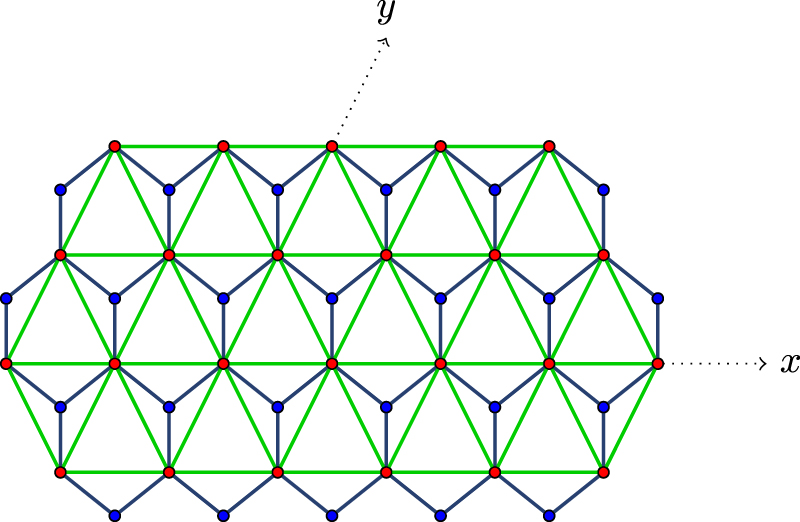
This simplified calculation method is useful not only for graphene. The authors suggest that their approach could also be applied to other carbon structures, such as fullerenes.
Victor Buchstaber
'We hypothesised that as the size of a molecule increases, random fullerenes become locally more similar in structure to an infinite graphene lattice. If this can be rigorously proven, the spectral properties of fullerenes could be derived from those of graphene, greatly simplifying their analysis,' explains Viktor Buchstaber from the International Laboratory of Algebraic Topology and Its Applications at the HSE Faculty of Computer Science.

See also:

HSE Students Among Winners of Yandex High-Tech Startup Accelerator
Yandex has announced the results of its Yandex AI Startup Lab accelerator, whose final round featured 12 IT projects. Over the course of three months, their creators—students and young entrepreneurs—worked alongside the company’s experts to develop their products. Four startups in digital marketing, medicine, and robotics were named the best, with their teams receiving cash prizes and cloud resource grants. Among them was Gradius, a startup founded by students from HSE University.
Researchers Find More Effective Approach to Revealing Majorana Zero Modes in Superconductors
An international team of researchers, including physicists from HSE MIEM, has demonstrated that nonmagnetic impurities can help more accurately reveal Majorana zero modes—quantum states considered promising building blocks for quantum computing. The researchers found that these impurities shift the energy levels that typically obscure the Majorana signal, while leaving the mode itself largely unaffected, thereby making its spectral peak more distinct. The study has been published in Research.
New Development by HSE Scientists Helps Design Reliable Electronics Faster at a Lower Cost
Scientists from HSE MIEM have developed a new approach to modelling electrothermal processes in high-power electronic circuits on printed circuit boards (PCB). The method allows engineers to quickly and accurately predict how electronic components heat up during operation, helping prevent overheating and potential failures. The results have been published in Russian Microelectronics.
The Future of Cardiogenetics Lies in Artificial Intelligence
Researchers from the AI and Digital Science Institute at the HSE Faculty of Computer Science have developed a program capable of analysing regions of the human genome that were previously inaccessible for accurate interpretation in genetic testing. The program adapts large generative AI (GenAI) models for cardiogenetics to predict how specific mutations affect the function of individual genes.
HSE Researchers: Young Russians Have Sufficient Knowledge About Money but Lack Money Management Skills
Adolescents and young adults in Russia today are well versed in financial terminology: they know what bank cards, loans, interest rates, and online payments are. However, as researchers at HSE University have found, real money-management skills remain poorly developed among most young people. The study ‘Financial Literacy, Financial Culture, and Financial Autonomy of Youth’ has been published in Monitoring of Public Opinion: Economic and Social Changes.
Why Weaker Competitors Give Up—and How to Keep Them in the Game
Anastasia Antsygina, Assistant Professor at HSE University’s Faculty of Economic Sciences, has developed a prize distribution model that maximises competitor engagement. She proposed revising the traditional ‘winner-takes-all’ approach and, in certain cases, offering a small reward even to those who have lost. According to her, this could increase participant motivation and make the competition more intense. The findings of her research were published in the Economic Theory journal.
HSE Researchers Compile Scientific Database for Studying Children’s Eating Habits
The database created at HSE University can serve as a foundation for studying children’s eating habits. This is outlined in the study ‘The Influence of Age, Gender, and Social-Role Factors on Children’s Compliance with Age-Based Nutritional Norms: An Experimental Study Using the Dish-I-Wish Web Application.’ The work has been carried out as part of the HSE Basic Research Programme and was presented at the XXVI April International Academic Conference named after Evgeny Yasin.
New Foresight Centre Study Identifies the Most Destructive Global Trends for Humankind
A team of researchers from the HSE International Research and Educational Foresight Centre has examined how global trends affect the quality of human life—from life expectancy to professional fulfilment. The findings of the study titled ‘Human Capital Transformation under the Influence of Global Trends’ were published in Foresight.
Scientists Develop Algorithm for Accurate Financial Time Series Forecasting
Researchers at the HSE Faculty of Computer Science benchmarked more than 200,000 model configurations for predicting financial asset prices and realised volatility, showing that performance can be improved by filtering out noise at specific frequencies in advance. This technique increased accuracy in 65% of cases. The authors also developed their own algorithm, which achieves accuracy comparable to that of the best models while requiring less computational power. The study has been published in Applied Soft Computing.
Electronics of the Future: Why Superconductors and Spintronics Work Together
It was once believed that superconductivity and magnetism avoided each other like the devil avoids holy water. However, modern nanostructures prove the opposite. A Russian theoretical physicist and Indian experimentalists have joined forces to create the electronics of the future—free from energy losses. Nataliya Pugach, Professor at the School of Electronic Engineering at HSE MIEM and Leading Research Fellow at the Quantum Nanoelectronics Laboratory, explains how a long-standing acquaintance in Cambridge grew into a mirror laboratory project with the Indian Institute of Technology Bombay (IIT Bombay), how superconducting spintronics works, and what surprises a researcher in India beyond the university campus.