

Taming the Element: How AI Is Integrating into the Educational Process Around the World
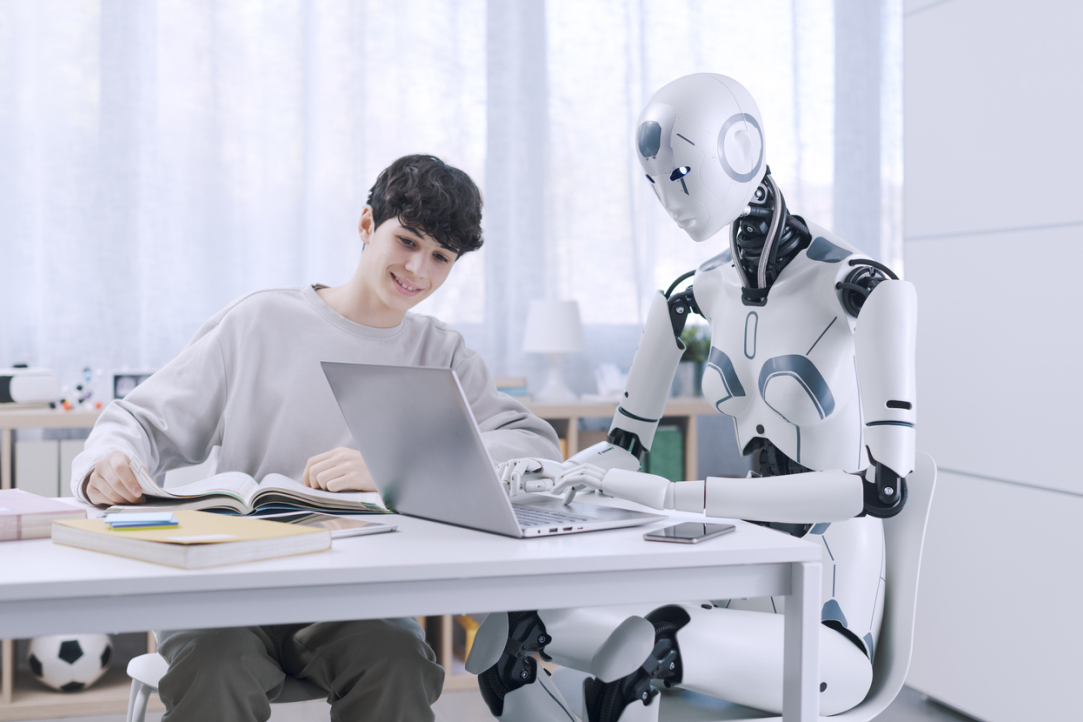
Artificial intelligence is gradually becoming an indispensable part of higher education. Both students and teachers use it to reduce the volume of routine tasks and expand their capabilities. The limitations and prospects of AI are discussed in the report ‘The Beginning of the End or a New Era? The Effects of Generative Artificial Intelligence (GAI) in Higher Education,’ published in the journal Modern Education Analytics, under the scientific supervision of HSE Academic Supervisor Yaroslav Kuzminov.
The authors themselves used AI in preparing the report. In particular, ChatGPT helped analyse articles, group research, structure the report, and improve the text's quality. AI is seen as an emergent innovation penetrating various segments of university activities, the report notes. The impact of artificial intelligence on education has grown exponentially since the emergence of GPT and similar models. There has also been a surge in interest in the topic from researchers since 2023. However, the main research issue is that AI in education is often viewed from a dual perspective: ‘good’ vs ‘bad,’ ‘for the student’ vs ‘for the teacher.’

Yaroslav Kuzminov
‘The most popular research questions currently being actively discussed in scientific debates are: is AI dangerous for educational institutions as a phenomenon, and does it lead to degradation? Should the use of models be regulated in general, and where is the boundary between their useful and harmful applications? Will the teaching profession disappear? These questions are often posed separately, which is a mistake; education should always have two sides,’ noted Yaroslav Kuzminov.
The report considers these issues together in order to understand the cumulative effect and contribution of AI to education.
The authors of the report highlight the leading countries in terms of the number of publications on AI usage and the specifics of their thematic focus. For example, in the United States, most publications focus on the integration of AI into programming, medical education, STEM fields, and combating fraud. Chinese researchers are primarily interested in academic integrity, inclusive education, and the development of AI literacy. In the United Kingdom, studies focus on using AI in interdisciplinary research and creative writing. Australia's scientific interest lies in innovations in teaching, digital literacy, and support for students and teachers. Spain focuses on AI's role in supporting creative thinking and language learning. Researchers from India are interested in inclusive design, Malaysia in supporting self-learning, and Germany in interactive learning.
The prevalence of AI usage varies across countries, depending on the characteristics of their education systems, the digital skills of students and universities, and their proficiency in English. For instance, a study by authors from Hong Kong showed that over 60% of students used GAI for academic purposes, while the figure was just over 40% for the UAE, 85% for Lebanon, and about 21% for Russia.
The scientific papers widely describe how AI is used in education by both teachers and students. However, most works in this area are hypothetical or based on very localised practical experience. Fewer studies rely on large samples and advanced data analysis methods. Empirical works are often replaced by essays discussing the risks of using AI. A significant portion of the works includes recommendations for educational policy, and this share is much higher than average.
Many studies focus on the legality of AI use by students for completing academic tasks. While students are interested in using AI effectively and quickly to complete assignments and improve their AI skills, teachers strive to identify instances of its use and, in cases where it is explicitly prohibited, hold students accountable. Publications systematically discussing the real possibilities and, especially, limitations of AI are rare.

‘At the same time, the scientific debate surrounding AI in higher education often takes a speculative nature. Some authors have an incomplete or often even incorrect understanding of how AI tools work, confusing GAI with other forms of AI. Many of the recommendations offered in the literature are not evidence-based. They often do not provide practical tools for effectively implementing GAI in educational practice and improving the user experience,’ the report emphasises.
The potential of AI can only be fully realised with a balanced, ethically justified, and pedagogically sound approach to its implementation, believes Yaroslav Kuzminov.
‘There is a need to adapt curricula and assessment methods, teach students and teachers to use GAI responsibly, and develop effective measures against academic fraud (or, conversely, abandon forms of control where academic fraud using GAI is possible)—all of this requires further research and the introduction of new approaches,’ he noted. ‘Teachers and educational institutions must actively work on integrating these technologies to minimise risks and maximise the benefits of their application.’
The academic supervisor of HSE University believes that future research should critically focus on developing specific, practically applicable methodologies for integrating AI into the educational process, with proven effectiveness. There should also be more attention given to studying the long-term consequences of AI usage in education and developing ethical frameworks for its application.
See also:

Artificial Intelligence Transforms Employment in Russian Companies
Russian enterprises rank among the world’s top ten leaders in AI adoption. In 2023, nearly one-third of domestic companies reported using artificial intelligence. According to a new study by Larisa Smirnykh, Professor at the HSE Faculty of Economic Sciences, the impact of digitalisation on employment is uneven: while the introduction of AI in small and large enterprises led to a reduction in the number of employees, in medium-sized companies, on the contrary, it contributed to job growth. The article has been published in Voprosy Ekonomiki.
HSE Seeks New Ideas for AI Agents: Initiative Competition Launched
HSE University is inviting researchers and lecturers to present concepts for new digital products based on artificial intelligence. The best projects will receive expert and technological support. Applications are open until December 19, 2025.
Final of International Yandex–HSE Olympiad in AI and Data Analysis Held at HSE University
Yandex Education and the HSE Faculty of Computer Science have announced the results of the international AIDAO (Artificial Intelligence and Data Analysis Olympiad) competition. Students from 14 countries took part. For the second year in a row, first place went to the team AI Capybara, which developed the most accurate AI model for an autonomous vehicle vision system.
AI Lingua Included in Compilation of Best International AI Practices in Higher Education
HSE University has been acknowledged internationally for its pioneering efforts in integrating artificial intelligence into higher education. The AI Lingua Neural Network developed at HSE was included in the renowned international collection ‘The Global Development of AI-Empowered Higher Education: Beyond the Horizon.’ The compilation was prepared by the Institute of Education (IOE) of Tsinghua University with the support of the Ministry of Education of the People's Republic of China and a global advisory committee, which included experts from Oxford, UCL, Sorbonne, Stanford, and other leading academic centres.
Technological Breakthrough: Research by AI and Digital Science Institute Recognised at AI Journey 2025
Researchers from the AI and Digital Science Institute (part of the HSE Faculty of Computer Science) presented cutting-edge AI studies, noted for their scientific novelty and practical relevance, at the AI Journey 2025 International Conference. A research project by Maxim Rakhuba, Head of the Laboratory for Matrix and Tensor Methods in Machine Learning, received the AI Leaders 2025 award. Aibek Alanov, Head of the Centre of Deep Learning and Bayesian Methods, was among the finalists.
HSE University to Join Physical AI Garage Project by Yandex
Yandex is collaborating with leading Russian universities to launch a new educational programme called Physical AI Garage. This initiative unites five universities—HSE University, ITMO, MIPT, MAI, and MEPhI—to train future professionals in physical artificial intelligence by tackling real-world industrial challenges. The programme is free, and participants will receive scholarships.
Larger Groups of Students Use AI More Effectively in Learning
Researchers at the Institute of Education and the Faculty of Economic Sciences at HSE University have studied what factors determine the success of student group projects when they are completed with the help of artificial intelligence (AI). Their findings suggest that, in addition to the knowledge level of the team members, the size of the group also plays a significant role—the larger it is, the more efficient the process becomes. The study was published in Innovations in Education and Teaching International.
HSE Researchers Assess Creative Industry Losses from Use of GenAI
Speaking at the IPQuorum.Music forum on October 15, Leonid Gokhberg, HSE First Vice Rector, and Daniil Kudrin, an expert at the Centre for Industry and Corporate Projects of HSE ISSEK, presented the findings of the first study in Russia on the economic impact of GenAI on creative professions. The analysis shows that creators’ potential losses could reach one trillion roubles by 2030.
‘Fall into ML Has Firmly Established Itself as a Landmark Event in Russia’s AI Scene’
On October 24–25, 2025, the AI and Digital Science Institute of the HSE Faculty of Computer Science will host the fourth annual Fall into ML 2025 conference at the HSE Cultural Centre. The event is once again supported by its general partner, Sber. The focus this year is on breakthrough research and the future of fundamental AI.
Critique of Obscure Reason: Artificial Intelligence in the Perception of Mathematicians
Mathematicians at HSE University believe that there is no need to fear losing jobs because of the widespread use of AI, while at the same time they warn against uncritical acceptance of works and projects prepared with its help. AI, however, can be a useful tool in research, creating models and processing large volumes of information.