

Neuroscientists from HSE University Learn to Predict Human Behaviour by Their Facial Expressions
Willingness to donate to charity is written all over the face.
Researchers at the Institute for Cognitive Neuroscience at HSE University are using automatic emotion recognition technologies to study charitable behaviour. In an experiment, scientists presented 45 participants with photographs of dogs in need and invited them to make donations to support these animals. Emotional reactions to the images were determined through facial activity using the FaceReader program. It turned out that the stronger the participants felt sadness and anger, the more money they were willing to donate to charity funds, regardless of their personal financial well-being. The study was published in the journal Heliyon.
The research was supported by a mega-grant from the Russian government as part of the national project ‘Science and Universities.’
Charitable behaviour is a complex psychological process with motives that are not fully understood. Emotional state is one of the key factors influencing the willingness to give one's resources to another. However, the question of how specific emotions are related to donations remains a subject of debate, as previous studies on this topic have yielded conflicting results.
One of the main reasons is methodological limitations in data collection. Most studies on charitable behaviour use subjective methods: volunteers themselves report their emotions and how they affect donations. However, participants do not always understand their feelings or are not willing to speak about them openly. Moreover, depending on the direction of charitable activity (helping sick people, helping animals, supporting environmental initiatives, and others), the same emotions can differently influence the willingness to donate. Therefore, to develop effective charity advertising, it is important to have objective data on the influence of emotions on the willingness to donate, taking into account the goals of fundraising.
Researchers Anna Shepelenko, Vladimir Kosonogov, and Anna Shestakova from the HSE Institute for Cognitive Neuroscience were the first in the world to use an automatic emotion recognition program to evaluate the effectiveness of charity appeals. In the experiment, scientists used FaceReader to record the facial expressions of volunteers while viewing photos of dogs in various conditions, including homeless, domestic, sick, healthy, adult, and puppies. Participants were given 320 rubles, which they could fully or partially donate to the animal aid fund during the experiment. The remaining amount could be kept for themselves.
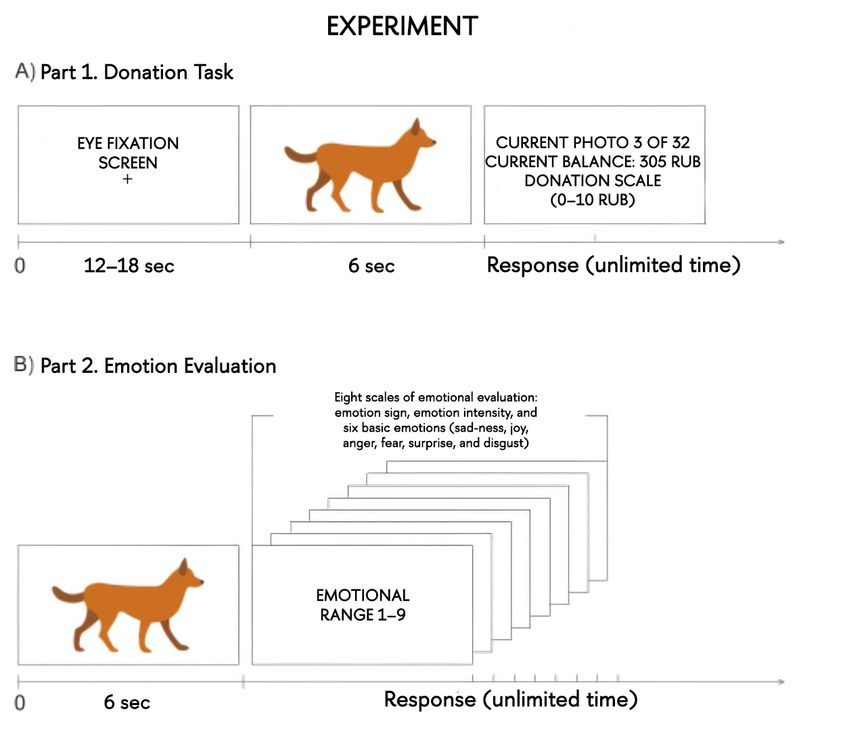
Dogs were specifically chosen for the study because society's attitude towards them is ambiguous: they can be perceived as both victims and threats. In these conditions, charity appeals can evoke contradictory or hidden emotions that are difficult to detect through surveys or focus groups but can be recognised by facial expressions.

Co-author of the study, Junior Research Fellow at the Centre for Cognition & Decision Making at the Institute for Cognitive Neuroscience, HSE University
Currently, affective computing is still in the early stages of its development and is not widely used in the industry. However, in the coming years, its widespread implementation in various business and scientific fields can be expected. Technologies like FaceReader are already being used for diagnosing mental disorders, improving the quality of online education, assessing customer satisfaction, and in some other areas. Our study clearly shows the prospects of using affective computing to predict the effectiveness of social advertising, creating a basis for further research and practical application.
The main results of the study showed that people are inclined to donate more when charity appeals provoke unpleasant emotions in them. In particular, participants gave larger amounts to animals whose images evoked sadness and anger. These results are confirmed by both self-reports of emotions and affective computing data.
At the same time, for some other emotions, researchers found differences between survey data and FaceReader data. According to self-reports, surprise, disgust, and fear also contributed to increased donations, but FaceReader data did not confirm this. According to the authors, these differences may have arisen due to the timing of emotion recording: the program analysed reactions during the first presentation of pictures and immediately before the donation decision, whereas self-reports were made after a second viewing of the images. This time gap could have changed participants' perception of their emotions.
Additionally, the formulation of questions about specific emotions could have caused cognitive biases and influenced respondents' answers so that they indicated not only the emotions they experienced but also those they considered appropriate depending on the context of the image. Based on this, researchers conclude that affective computing complements self-report data, allowing for a more accurate identification of emotions at the moment of decision-making and reducing the influence of experimental procedures or cognitive biases on research results.
It is noteworthy that donations were associated with the individual perception of the value of money: the higher the subjective significance of the reward for participating in the experiment (320 rubles), the less willing participants were to donate to charity, while their personal level of financial well-being did not affect the amount of donations. This data clarifies the results of earlier publications, which showed contradictions regarding the relationship between financial well-being and the willingness to make donations.
Co-author of the study, Junior Research Fellow at the Centre for Cognition & Decision Making at the Institute for Cognitive Neuroscience, HSE University
This study contributes to the understanding of charitable behaviour, and we hope that the obtained results will be useful for non-profit organisations. At the same time, it is important to note some limitations: our results do not take into account the long-term impact of charity advertising on the audience.
Indeed, unpleasant emotions can increase the amount of donations during initial contact, but regularly repeated negative charity appeals can provoke empathy fatigue or avoidance—people may simply exclude such messages from their information field. Thus, to further study the impact of emotions on charity, longitudinal studies should be conducted, in which changes in donors' behaviour can be registered over several months or even years.
See also:

Scientists Discover Why Parents May Favour One Child Over Another
An international team that included Prof. Marina Butovskaya from HSE University studied how willing parents are to care for a child depending on the child’s resemblance to them. The researchers found that similarity to the mother or father affects the level of care provided by parents and grandparents differently. Moreover, this relationship varies across Russia, Brazil, and the United States, reflecting deep cultural differences in family structures in these countries. The study's findings have been published in Social Evolution & History.
When a Virus Steps on a Mine: Ancient Mechanism of Infected Cell Self-Destruction Discovered
When a virus enters a cell, it disrupts the cell’s normal functions. It was previously believed that the cell's protective response to the virus triggered cellular self-destruction. However, a study involving bioinformatics researchers at HSE University has revealed a different mechanism: the cell does not react to the virus itself but to its own transcripts, which become abnormally long. The study has been published in Nature.
Researchers Identify Link between Bilingualism and Cognitive Efficiency
An international team of researchers, including scholars from HSE University, has discovered that knowledge of a foreign language can improve memory performance and increase automaticity when solving complex tasks. The higher a person’s language proficiency, the stronger the effect. The results have been published in the journal Brain and Cognition.
Artificial Intelligence Transforms Employment in Russian Companies
Russian enterprises rank among the world’s top ten leaders in AI adoption. In 2023, nearly one-third of domestic companies reported using artificial intelligence. According to a new study by Larisa Smirnykh, Professor at the HSE Faculty of Economic Sciences, the impact of digitalisation on employment is uneven: while the introduction of AI in small and large enterprises led to a reduction in the number of employees, in medium-sized companies, on the contrary, it contributed to job growth. The article has been published in Voprosy Ekonomiki.
Lost Signal: How Solar Activity Silenced Earth's Radiation
Researchers from HSE University and the Space Research Institute of the Russian Academy of Sciences analysed seven years of data from the ERG (Arase) satellite and, for the first time, provided a detailed description of a new type of radio emission from near-Earth space—the hectometric continuum, first discovered in 2017. The researchers found that this radiation appears a few hours after sunset and disappears one to three hours after sunrise. It was most frequently observed during the summer months and less often in spring and autumn. However, by mid-2022, when the Sun entered a phase of increased activity, the radiation had completely vanished—though the scientists believe the signal may reappear in the future. The study has been published in the Journal of Geophysical Research: Space Physics.
‘Engagement in the Scientific Process’: HSE Launches Master’s Programme in Neurobiology
The HSE University Academic Council has elected to launch a new Master's programme in Neurobiology for students majoring in Biology. Students of the programme will have access to unique equipment and research groups, providing them with the knowledge and experience to pursue careers in science, medicine and pharmacy, IT and neurotechnology, and education and HR services.
Banking Crises Drive Biodiversity Loss
Economists from HSE University, MGIMO University, and Bocconi University have found that financial crises have a significant negative impact on biodiversity and the environment. This relationship appears to be bi-directional: as global biodiversity declines, the likelihood of new crises increases. The study examines the status of populations encompassing thousands of species worldwide over the past 50 years. The article has been published in Economics Letters, an international journal.
Scientists Discover That the Brain Responds to Others’ Actions as if They Were Its Own
When we watch someone move their finger, our brain doesn’t remain passive. Research conducted by scientists from HSE University and Lausanne University Hospital shows that observing movement activates the motor cortex as if we were performing the action ourselves—while simultaneously ‘silencing’ unnecessary muscles. The findings were published in Scientific Reports.
Russian Scientists Investigate Age-Related Differences in Brain Damage Volume Following Childhood Stroke
A team of Russian scientists and clinicians, including Sofya Kulikova from HSE University in Perm, compared the extent and characteristics of brain damage in children who experienced a stroke either within the first four weeks of life or before the age of two. The researchers found that the younger the child, the more extensive the brain damage—particularly in the frontal and parietal lobes, which are responsible for movement, language, and thinking. The study, published in Neuroscience and Behavioral Physiology, provides insights into how age can influence the nature and extent of brain lesions and lays the groundwork for developing personalised rehabilitation programmes for children who experience a stroke early in life.
Scientists Test Asymmetry Between Matter and Antimatter
An international team, including scientists from HSE University, has collected and analysed data from dozens of experiments on charm mixing—the process in which an unstable charm meson oscillates between its particle and antiparticle states. These oscillations were observed only four times per thousand decays, fully consistent with the predictions of the Standard Model. This indicates that no signs of new physics have yet been detected in these processes, and if unknown particles do exist, they are likely too heavy to be observed with current equipment. The paper has been published in Physical Review D.