

Adhesive Tape Helps Create Innovative THz Photodetector
It is 10,000 times thinner than a sheet of paper and has been inspired by the discovery made by Nobel Prize winners Andre Geim and Konstantin Novoselov.
An international team of researchers, including scientists at HSE University and Moscow Pedagogical State University (MPGU), has developed a novel photodetector composed of a thin superconducting film, capable of detecting weak terahertz (THz) radiation. This discovery holds promise for studying objects in space, developing wireless broadband communication systems, and making advancements in spectroscopy. The study has been published in Nano Letters.
The study was conducted with support from the Russian Science Foundation (RSF), Projects No. 21-72-10117 and No. 23-72-00014.
Superconducting Hot-Electron Bolometers are a type of highly sensitive photodetectors capable of capturing low-intensity electromagnetic radiation in the terahertz range. These detectors find application in astronomy for studying space objects such as stars, galaxies, and cosmic microwave radiation. Additionally, they are sought after in security and medical diagnostic systems, as they facilitate the visualisation of concealed objects with resolutions reaching hundreds of micrometres.
When the photosensitive element of such a detector absorbs electromagnetic radiation, it undergoes local heating, leading to the formation of thermalised electrons with kinetic energy surpassing the material's average electron energy. The emergence of overheated electrons causes a shift in the resistance of the photosensitive element, thereby generating an electrical signal that can be measured.
Current commercial superconducting bolometers employing overheated electrons are manufactured using films produced through magnetron sputtering techniques. This technology presently lacks the capability to produce materials thinner than a few nanometres, whereas the detector's performance is directly influenced by the deposition quality.
An international team of researchers, including scientists at MIEM HSE, have proposed using a thinner material and an alternative method for applying the detector’s photosensitive element. Taking inspiration from Nobel Prize winners Andre Geim and Konstantin Novoselov, who produced graphene by repeatedly cleaving graphite with adhesive tape, the study authors successfully obtained ultrathin films of niobium diselenide (NbSe2) by delaminating atomic layers from the material using polymer adhesive tape.

Research Fellow, MIEM HSE
We worked as part of a large international collaboration consisting of specialists in photodetectors and experts in two-dimensional materials. We pooled our expertise to develop a sensitive and compact terahertz radiation detector with a thickness of just a few atomic layers of niobium diselenide, which is 10,000 times thinner than a standard sheet of office paper. Furthermore, this technology enables us to obtain materials with an optimal structure. It is easy to apply and does not require specialised equipment.
The authors also investigated the reaction of NbSe2 to THz radiation. They examined how the material heats up upon exposure to an electromagnetic wave and how the detector's properties vary depending on its environment—the substrate and electrodes—given that two-dimensional materials are sensitive to their surroundings. The scientists have also identified the mechanisms that constrain the sensitivity and speed of the detector.
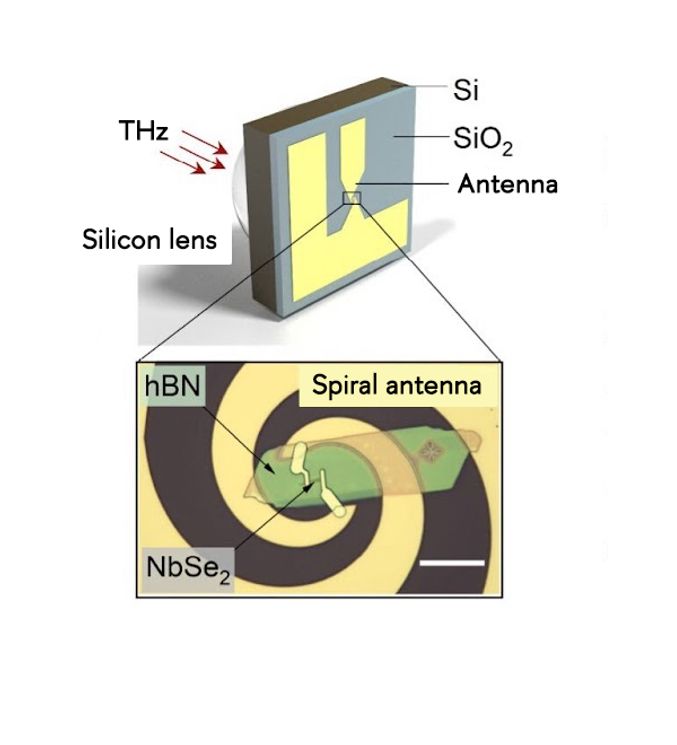
The scientists emphasise that their pioneering work to develop a bolometric THz radiation detector demonstrates the potential for such a device to eventually surpass existing commercial solutions.

Doctoral student and Research Fellow, MIEM HSE
We have demonstrated that using the proposed technology makes it possible to manufacture a bolometric THz radiation detector with characteristics similar to those of existing commercial counterparts.
See also:

Researchers Identify Link between Bilingualism and Cognitive Efficiency
An international team of researchers, including scholars from HSE University, has discovered that knowledge of a foreign language can improve memory performance and increase automaticity when solving complex tasks. The higher a person’s language proficiency, the stronger the effect. The results have been published in the journal Brain and Cognition.
Artificial Intelligence Transforms Employment in Russian Companies
Russian enterprises rank among the world’s top ten leaders in AI adoption. In 2023, nearly one-third of domestic companies reported using artificial intelligence. According to a new study by Larisa Smirnykh, Professor at the HSE Faculty of Economic Sciences, the impact of digitalisation on employment is uneven: while the introduction of AI in small and large enterprises led to a reduction in the number of employees, in medium-sized companies, on the contrary, it contributed to job growth. The article has been published in Voprosy Ekonomiki.
Lost Signal: How Solar Activity Silenced Earth's Radiation
Researchers from HSE University and the Space Research Institute of the Russian Academy of Sciences analysed seven years of data from the ERG (Arase) satellite and, for the first time, provided a detailed description of a new type of radio emission from near-Earth space—the hectometric continuum, first discovered in 2017. The researchers found that this radiation appears a few hours after sunset and disappears one to three hours after sunrise. It was most frequently observed during the summer months and less often in spring and autumn. However, by mid-2022, when the Sun entered a phase of increased activity, the radiation had completely vanished—though the scientists believe the signal may reappear in the future. The study has been published in the Journal of Geophysical Research: Space Physics.
Banking Crises Drive Biodiversity Loss
Economists from HSE University, MGIMO University, and Bocconi University have found that financial crises have a significant negative impact on biodiversity and the environment. This relationship appears to be bi-directional: as global biodiversity declines, the likelihood of new crises increases. The study examines the status of populations encompassing thousands of species worldwide over the past 50 years. The article has been published in Economics Letters, an international journal.
Scientists Discover That the Brain Responds to Others’ Actions as if They Were Its Own
When we watch someone move their finger, our brain doesn’t remain passive. Research conducted by scientists from HSE University and Lausanne University Hospital shows that observing movement activates the motor cortex as if we were performing the action ourselves—while simultaneously ‘silencing’ unnecessary muscles. The findings were published in Scientific Reports.
Russian Scientists Investigate Age-Related Differences in Brain Damage Volume Following Childhood Stroke
A team of Russian scientists and clinicians, including Sofya Kulikova from HSE University in Perm, compared the extent and characteristics of brain damage in children who experienced a stroke either within the first four weeks of life or before the age of two. The researchers found that the younger the child, the more extensive the brain damage—particularly in the frontal and parietal lobes, which are responsible for movement, language, and thinking. The study, published in Neuroscience and Behavioral Physiology, provides insights into how age can influence the nature and extent of brain lesions and lays the groundwork for developing personalised rehabilitation programmes for children who experience a stroke early in life.
Scientists Test Asymmetry Between Matter and Antimatter
An international team, including scientists from HSE University, has collected and analysed data from dozens of experiments on charm mixing—the process in which an unstable charm meson oscillates between its particle and antiparticle states. These oscillations were observed only four times per thousand decays, fully consistent with the predictions of the Standard Model. This indicates that no signs of new physics have yet been detected in these processes, and if unknown particles do exist, they are likely too heavy to be observed with current equipment. The paper has been published in Physical Review D.
HSE Scientists Reveal What Drives Public Trust in Science
Researchers at HSE ISSEK have analysed the level of trust in scientific knowledge in Russian society and the factors shaping attitudes and perceptions. It was found that trust in science depends more on everyday experience, social expectations, and the perceived promises of science than on objective knowledge. The article has been published in Universe of Russia.
Scientists Uncover Why Consumers Are Reluctant to Pay for Sugar-Free Products
Researchers at the HSE Institute for Cognitive Neuroscience have investigated how 'sugar-free' labelling affects consumers’ willingness to pay for such products. It was found that the label has little impact on the products’ appeal due to a trade-off between sweetness and healthiness: on the one hand, the label can deter consumers by implying an inferior taste, while on the other, it signals potential health benefits. The study findings have been published in Frontiers in Nutrition.
HSE Psycholinguists Launch Digital Tool to Spot Dyslexia in Children
Specialists from HSE University's Centre for Language and Brain have introduced LexiMetr, a new digital tool for diagnosing dyslexia in primary school students. This is the first standardised application in Russia that enables fast and reliable assessment of children’s reading skills to identify dyslexia or the risk of developing it. The application is available on the RuStore platform and runs on Android tablets.