

HSE Neural Interface Technology to Be Introduced in Hospitals
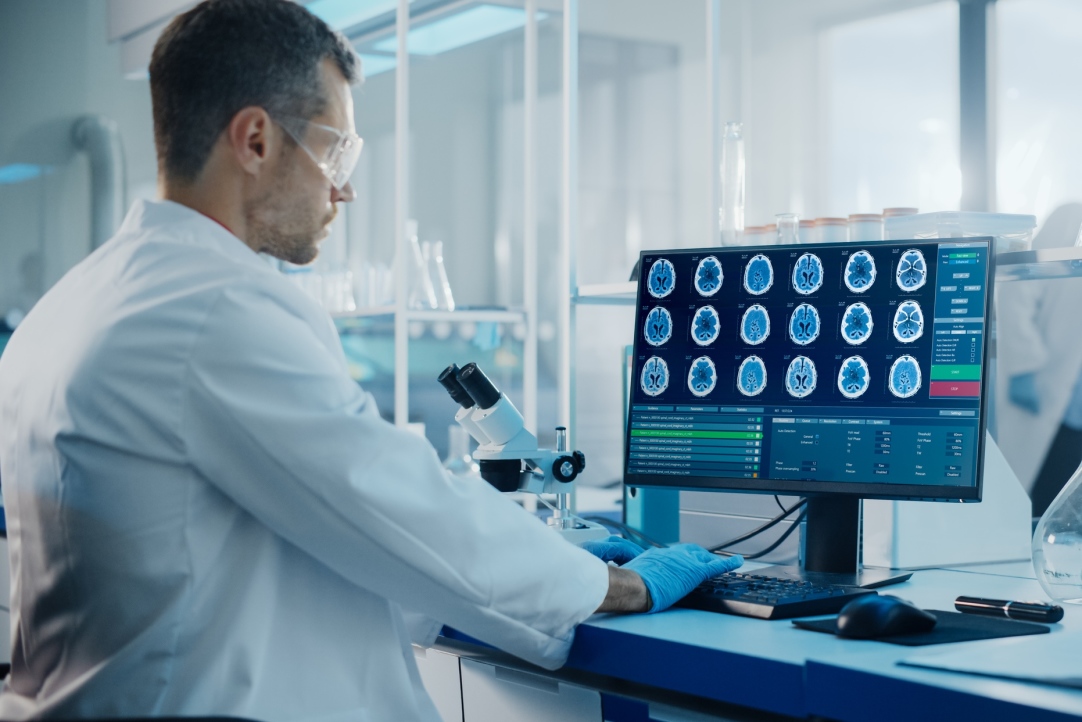
The Federal Brain and Neural Technology Centre at the Federal Medical and Biological Agency is launching the Laboratory of Medical Neural Interfaces and Artificial Intelligence for Clinical Applications, which has been created by employees of HSE University. Read below to find out about the Laboratory and its objectives.
The laboratory has been created as part of the Neurocampus 2030 project, which is being implemented by a consortium of the Federal Brain and Neural Technology Centre (a flagship clinical research organisation that conducts research into pathologies of the nervous system and provides high-tech medical care), the Pirogov Russian Research Medical University and the Institute of Higher Nervous Activity and Neurophysiology of the Russian Academy of Sciences.
Alexey Ossadtchi, Director of the HSE Centre for Bioelectric Interfaces, is the Head of the Laboratory. Apart from professional development and extra income for his staff (which are important for maintaining and developing a unique research team), his interest in a long-term partnership with the Federal Brain and Neural Technology Centre and in working at Neurocampus in south-west Moscow lies in the opportunity to access clinical facilities, ie to work with patients.

‘Over a number of years, our Centre for Bioelectric Interfaces has developed a number of technologies that meet medical professionals’ needs and are based on methods of brain mapping. Such methods allow us to identify the location of individual cortical functions. These technologies require translational research and implementation into clinical practice,’ says Alexey Ossadtchi.
Treating patients with epilepsy that is not amenable to medication may require surgery to remove the area of the cerebral cortex where seizures begin. Before the surgery, such areas must be located as accurately as possible, ideally without further surgery. The laboratory is going to combine different methods of functional brain mapping (magnetoencephalography, electroencephalography, positron emission tomography, magnetic resonance imaging, etc), which will enable surgeons to remove these areas noninvasively.
Researchers face a number of technical issues related to assessing the effectiveness of the various techniques and synthesising the information obtained. They will be interacting with doctors to explain their findings, and the doctors will be able to articulate their needs as to what they expect to receive from the researchers. Consultative meetings and in-depth discussions are also scheduled. The final objective is to establish a diagnostic service for patients with epilepsy.
Another focus of the laboratory is the testing of passive speech-mapping methods and the development of minimally invasive systems for prosthetics of speech function—the creation of a ‘speech prosthesis’.
Having learned how to record the brain activity of people saying words to themselves in their heads, the researchers decided to take the next step and try to decode these words. The HSE Centre for Bioelectric Interfaces began developing the corresponding technology with support from Huawei. These R&D efforts will continue at the Laboratory of Medical Neural Interfaces and Artificial Intelligence for Clinical Applications. The ‘speech prosthesis’ is to be tested in clinical practice.
Brain activity will be read using electrodes—thin needles less than a millimetre in diameter, which are inserted into a certain area of the skull to read signals of brain activity. Such implantation of electrodes can be done under local anaesthesia.
In addition to clinical validation, the new laboratory will certify, patent, and commercialise their developments. With clinical cases available, researchers will not have to undergo lengthy testing or convince doctors of its necessity. The Priority 2030 programme will finance the laboratory for eight years. According to the creators of the technology, this period is sufficient to ensure commercialisation of the technology.
‘By opening a laboratory at the Federal Brain and Neural Technology Centre, we are rounding out the development cycle. On the one hand, we develop algorithms, techniques, and mathematical methods, and test them in the clinic. On the other hand, we communicate closely with doctors, understanding their objectives and aspirations, and we consider this in our development work. As a result, researchers and doctors can learn from each other, while patients receive more high-tech and, in some cases, less invasive and more effective medical care,’ says Alexey Ossadtchi.
See also:

Researchers Identify Link between Bilingualism and Cognitive Efficiency
An international team of researchers, including scholars from HSE University, has discovered that knowledge of a foreign language can improve memory performance and increase automaticity when solving complex tasks. The higher a person’s language proficiency, the stronger the effect. The results have been published in the journal Brain and Cognition.
‘Engagement in the Scientific Process’: HSE Launches Master’s Programme in Neurobiology
The HSE University Academic Council has elected to launch a new Master's programme in Neurobiology for students majoring in Biology. Students of the programme will have access to unique equipment and research groups, providing them with the knowledge and experience to pursue careers in science, medicine and pharmacy, IT and neurotechnology, and education and HR services.
Scientists Discover That the Brain Responds to Others’ Actions as if They Were Its Own
When we watch someone move their finger, our brain doesn’t remain passive. Research conducted by scientists from HSE University and Lausanne University Hospital shows that observing movement activates the motor cortex as if we were performing the action ourselves—while simultaneously ‘silencing’ unnecessary muscles. The findings were published in Scientific Reports.
Russian Scientists Investigate Age-Related Differences in Brain Damage Volume Following Childhood Stroke
A team of Russian scientists and clinicians, including Sofya Kulikova from HSE University in Perm, compared the extent and characteristics of brain damage in children who experienced a stroke either within the first four weeks of life or before the age of two. The researchers found that the younger the child, the more extensive the brain damage—particularly in the frontal and parietal lobes, which are responsible for movement, language, and thinking. The study, published in Neuroscience and Behavioral Physiology, provides insights into how age can influence the nature and extent of brain lesions and lays the groundwork for developing personalised rehabilitation programmes for children who experience a stroke early in life.
Scientists Uncover Why Consumers Are Reluctant to Pay for Sugar-Free Products
Researchers at the HSE Institute for Cognitive Neuroscience have investigated how 'sugar-free' labelling affects consumers’ willingness to pay for such products. It was found that the label has little impact on the products’ appeal due to a trade-off between sweetness and healthiness: on the one hand, the label can deter consumers by implying an inferior taste, while on the other, it signals potential health benefits. The study findings have been published in Frontiers in Nutrition.
Internal Clock: How Heart Rate and Emotions Shape Our Perception of Time
Our perception of time depends on heart rate—this is the conclusion reached by neuroscientists at HSE University. In their experiment, volunteers watched short videos designed to evoke specific emotions and estimated each video's duration, while researchers recorded their heart activity using ECG. The study found that the slower a participant's heart rate, the shorter they perceived the video to be—especially when watching unpleasant content. The study has been published in Frontiers in Psychology.
Scientists Develop New Method to Detect Motor Disorders Using 3D Objects
Researchers at HSE University have developed a new methodological approach to studying motor planning and execution. By using 3D-printed objects and an infrared tracking system, they demonstrated that the brain initiates the planning process even before movement begins. This approach may eventually aid in the assessment and treatment of patients with neurodegenerative diseases such as Parkinson’s. The paper has been published in Frontiers in Human Neuroscience.
HSE Scientists Test New Method to Investigate Mechanisms of New Word Acquisition
Researchers at the HSE Centre for Language and Brain were among the first to use transcranial alternating current stimulation to investigate whether it can influence the acquisition of new words. Although the authors of the experiment have not yet found a link between brain stimulation and word acquisition, they believe that adjusting the stimulation parameters may yield different results in the future. The study has been published in Language, Cognition and Neuroscience.
When Thoughts Become Movement: How Brain–Computer Interfaces Are Transforming Medicine and Daily Life
At the dawn of the 21st century, humans are increasingly becoming not just observers, but active participants in the technological revolution. Among the breakthroughs with the potential to change the lives of millions, brain–computer interfaces (BCIs)—systems that connect the brain to external devices—hold a special place. These technologies were the focal point of the spring International School ‘A New Generation of Neurointerfaces,’ which took place at HSE University.
How the Brain Responds to Prices: Scientists Discover Neural Marker for Price Perception
Russian scientists have discovered how the brain makes purchasing decisions. Using electroencephalography (EEG) and magnetoencephalography (MEG), researchers found that the brain responds almost instantly when a product's price deviates from expectations. This response engages brain regions involved in evaluating rewards and learning from past decisions. Thus, perceiving a product's value is not merely a conscious choice but also a function of automatic cognitive mechanisms. The results have been published in Frontiers in Human Neuroscience.